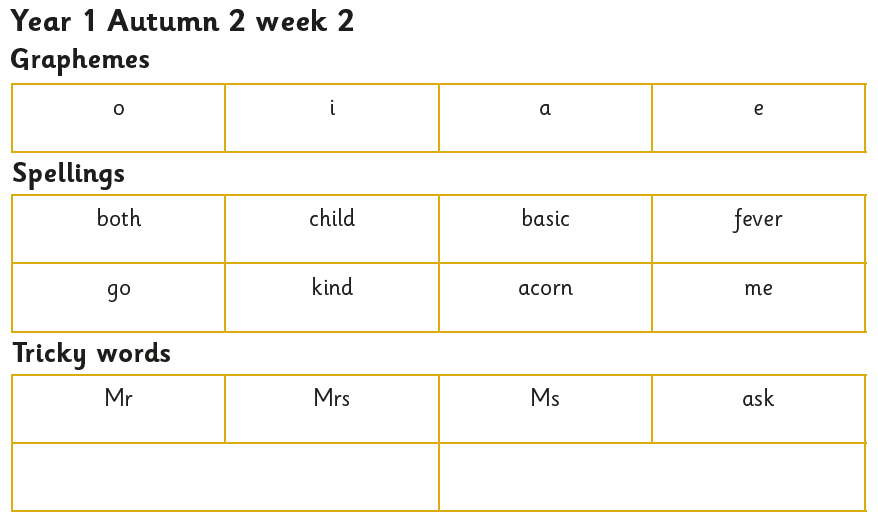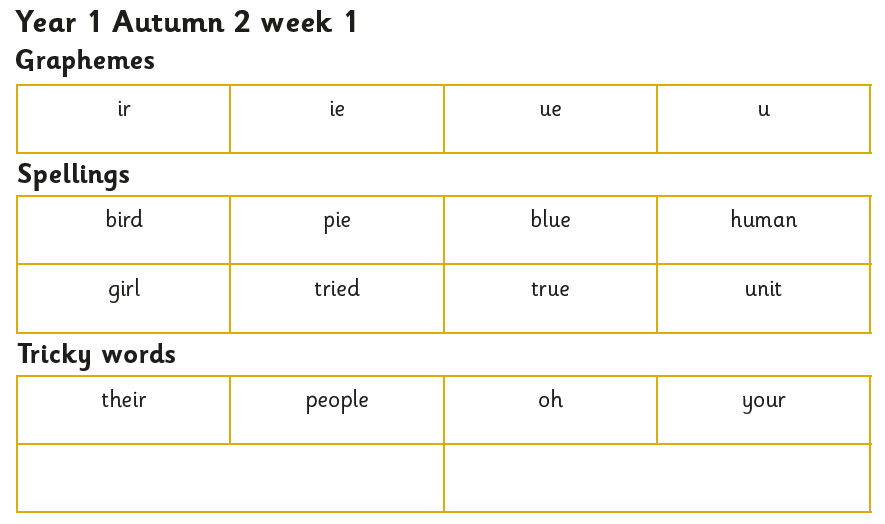
Please see the table below for details of the home learning tasks.
| Spellings |
This will be updated every Wednesday – Please note previous sounds and words are saved on the page for your reference Please remember that there are no spelling tests in Year 1. These activities are designed to build confidence and familiarity with reading and writing words. As stated by Little Wandle, repeated practice of spelling helps children move their new learning into their long-term memory. In Year 1 especially, it is important to try to find time to practise and embed spelling outside of the phonics lessons. Have a go with reading these words and sounds in preparation for your phonics lessons beginning on 14th September. You could put them on post it notes around the house and encourage your child to recognise the alternative grapheme and then read the word. Graphemes – Please continue to practise the previous digraphs 16.11.26
Dictation SentencesAutumn 2 week 2
|
| Maths | Please use the Mymaths details to login and complete the learning.
[Y1] Introducing 3D shapes Introducing common 3D shapes: cube, cuboid, sphere, cylinder, cone, pyramid; identifying examples of 3D shapes and recognising their properties (number of faces, edges and vertices). |